
Large language models are powerful, but they do not understand your business on their own. They do not know how your organization defines revenue, margin, customer, region, or inventory unless that logic is explicitly provided.
AtScale provides that missing business context. It gives AI agents a governed semantic layer that translates enterprise data into trusted definitions, metrics, relationships, and policies.
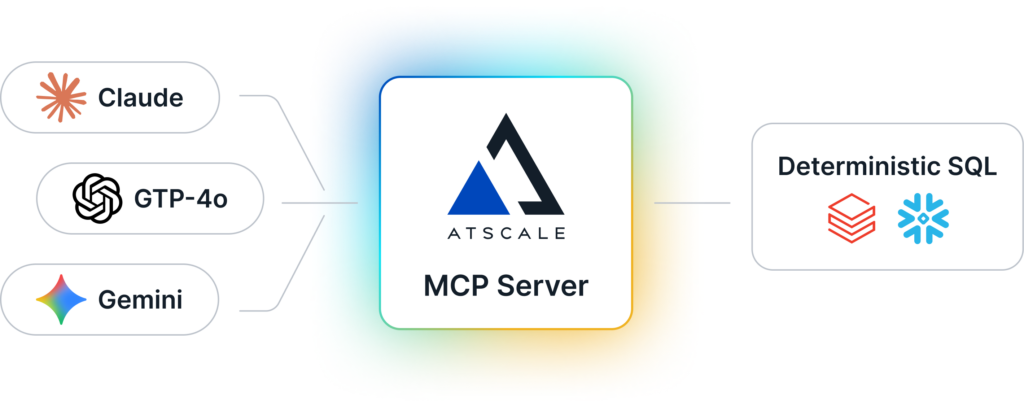
With AtScale’s Universal Semantic Layer and Model Context Protocol (MCP) integration, AI agents connect to semantic models that expose approved metrics, business logic, relationships, and security policies. Instead of guessing at tables and columns, they operate on governed context.
The result is more accurate answers, more consistent analytics, and a more trustworthy foundation for enterprise AI.

Why LLMs Struggle with Raw Enterprise Data
Many organizations are connecting AI directly to warehouse tables, documentation, or loosely defined metadata. But accessible data is not the same as understandable data.
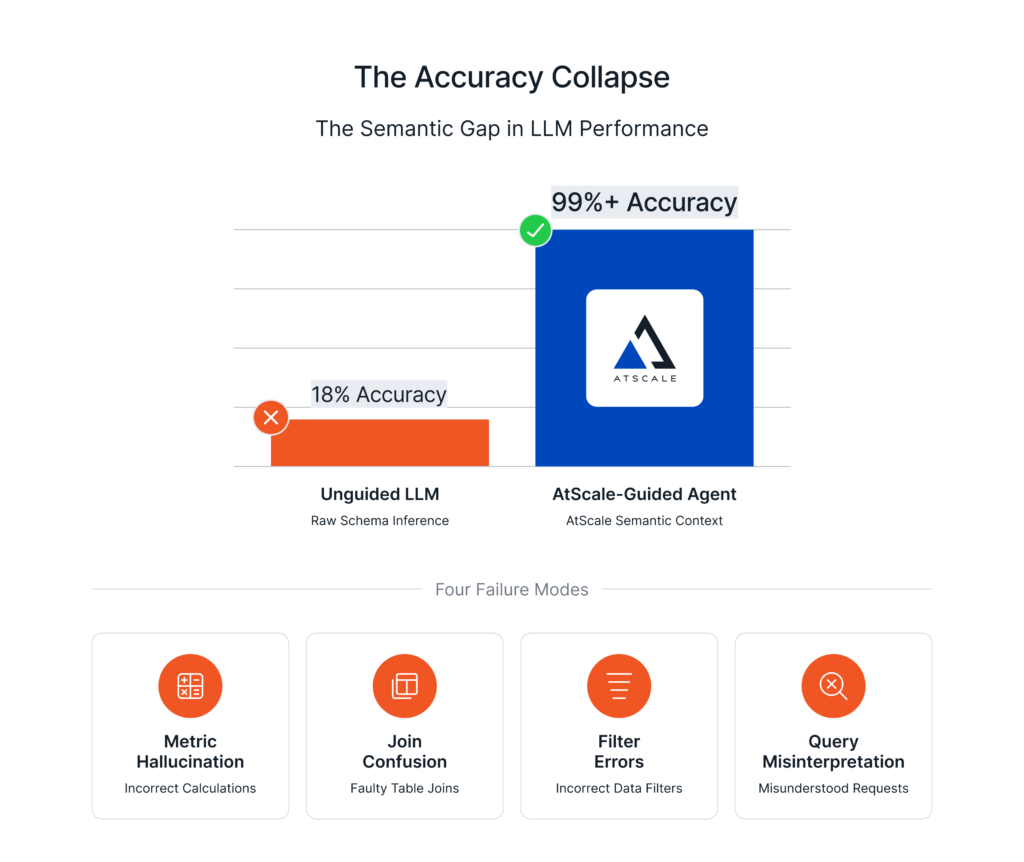
Raw tables do not tell an AI model which metric definition is approved, how customer churn is calculated, which joins are valid, or which policies must be enforced. This is the semantic gap: the disconnect between natural-language business questions and the technical structures of enterprise data.
When AI has to bridge that gap on its own, answers become inconsistent and trust erodes. Common failure modes include:
- Metric hallucination
- Join confusion
- Probabilistic results that drift over time
- Unauthorized or non-governed access paths
If AI is going to support real analytics, monitoring, or autonomous workflows, it needs more than data access. It needs governed business context.
How AtScale Provides Context for AI
AtScale bridges the semantic gap by exposing governed business context through its semantic layer, knowledge graph, and MCP integration.
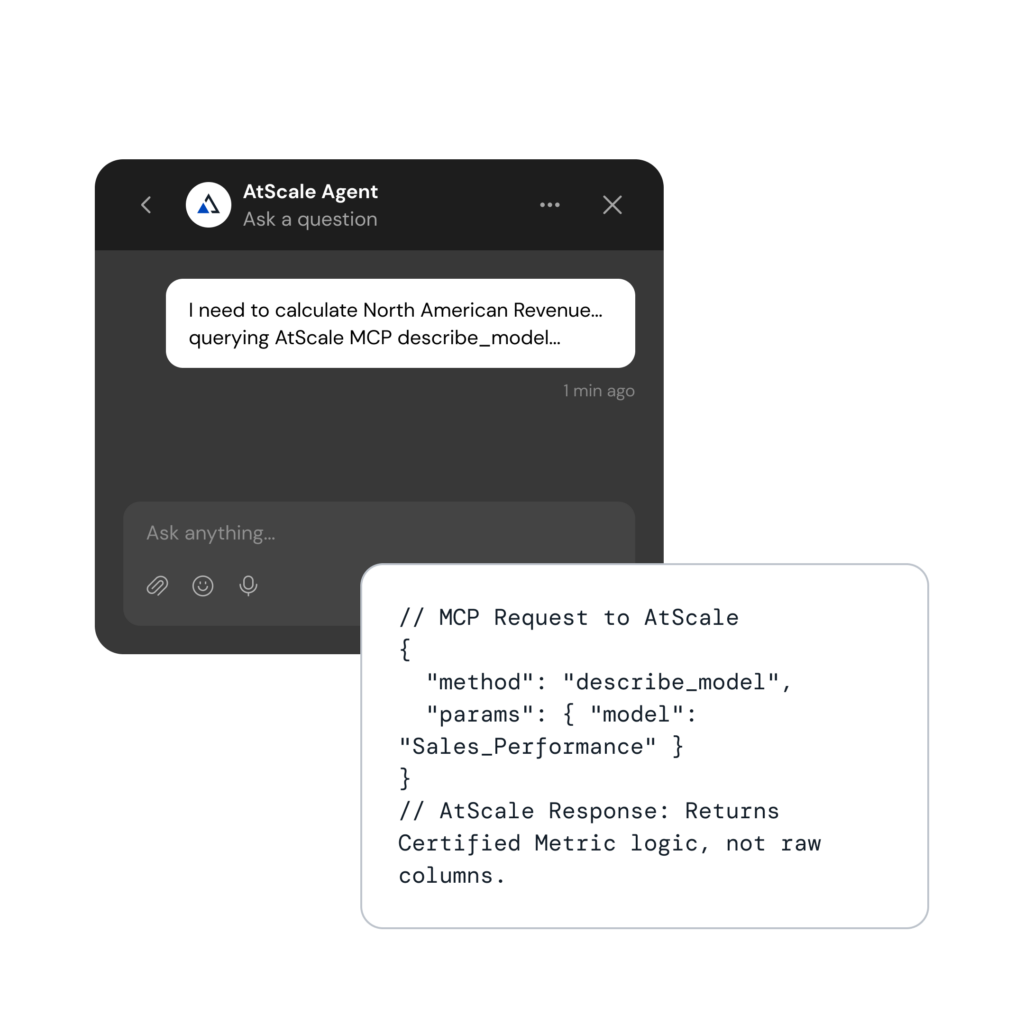
When a user or AI agent asks a question, AtScale resolves that request against trusted business definitions and translates it into platform-native queries. The result is AI that works from certified metrics, relationships, and policies instead of guessing from raw data. How it works:
1. Ask – A business user or AI agent submits a natural-language question.
2. Resolve – AtScale exposes the relevant semantic definitions, including metrics, dimensions, relationships, and access policies, so the AI system can understand the business meaning behind the request. Its knowledge graph helps connect those concepts across the model.
3. Return – AtScale generates governed queries that run directly in the underlying data platform, returning results based on certified logic rather than inferred schema assumptions.
The result is AI that operates on the same governed business logic your organization relies on for trusted analytics.
From Document Retrieval to Semantic Retrieval
Traditional retrieval approaches are useful for summarizing text, but they are not enough for governed analytics.
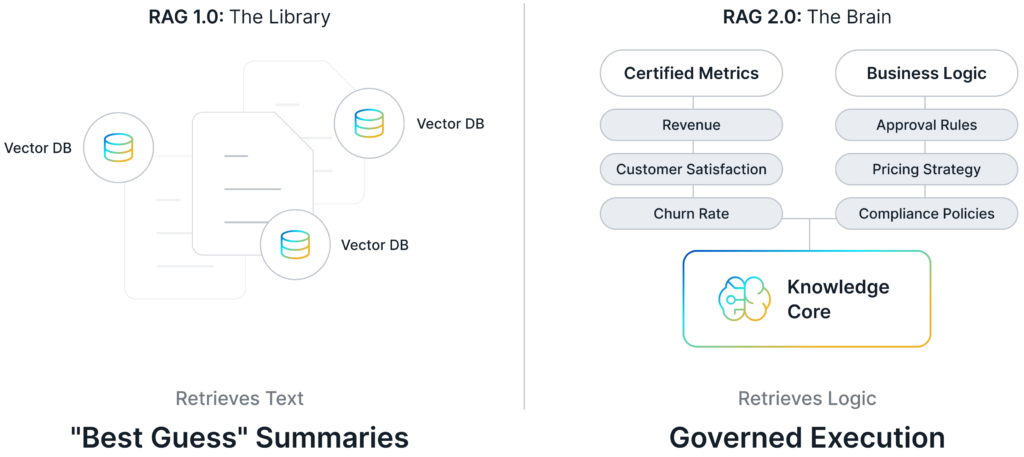
Document-based retrieval helps LLMs find paragraphs, articles, and descriptions. It does not provide the business logic needed to answer analytical questions consistently. Semantic retrieval helps AI understand how the business defines it.
Traditional retrieval
- Retrieves text and documentation
- Requires the model to infer business meaning
- Can produce inconsistent answers
Semantic retrieval with AtScale
- Retrieves certified metrics and business logic
- Gives the model explicit semantic context
- Supports more governed, explainable analytics
With AtScale, AI moves from interpreting documentation to operating on approved business semantics.
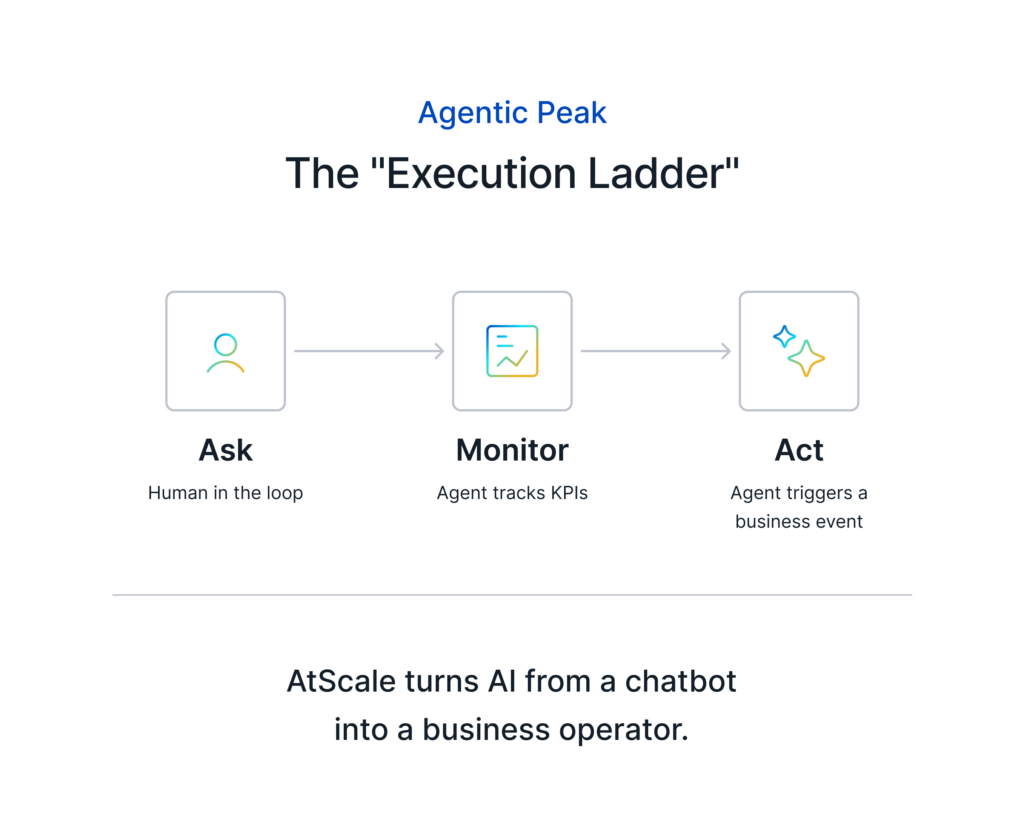
From Ask to Monitor to Act
Conversational analytics is only the start. With the right semantic foundation, organizations can move from one-time questions to autonomous workflows.
Ask – Users ask questions in natural language and get answers grounded in approved business logic.
Monitor – AI agents track governed metrics and detect meaningful changes in business conditions.
Act – Trusted outputs trigger downstream workflows, recommendations, or operational decisions.
AtScale helps make that progression possible by giving AI systems the semantic context they need to operate reliably beyond chat-based interactions.
Frequently Asked Questions
What is semantic context for AI?
Semantic context for AI is the business meaning that guides an AI system in correctly interpreting enterprise data. It includes governed metrics, dimensions, relationships, hierarchies, and policies.
Why do LLMs fail on raw enterprise tables?
Raw tables do not contain enough business meaning on their own. Without semantic context, LLMs must guess how data should be interpreted, joined, filtered, and governed.
What is the semantic gap?
The semantic gap is the difference between how people ask business questions and how enterprise data is physically structured in databases and warehouses.
How does AtScale help AI systems?
AtScale provides a semantic layer that exposes certified business logic to AI systems. This helps them answer questions and interact with data using governed definitions instead of raw schema inference.
What is the role of MCP in this workflow?
MCP provides a structured way for AI systems to access tools and context. In this case, it helps expose semantic definitions from AtScale so the model can work with business-ready context.
How is semantic retrieval different from document retrieval?
Document retrieval gives models text to summarize. Semantic retrieval gives them business definitions and analytical logic they can use to answer data questions more consistently.
What role does the knowledge graph play?
AtScale’s knowledge graph organizes relationships among business concepts such as metrics, dimensions, entities, hierarchies, and policies. This gives AI systems more structured context and helps them interpret enterprise data more reliably.
