Gartner opened the Data & Analytics Summit 2026 with a memorable metaphor. The keynote framed the current moment as a raft ride through a roaring, treacherous river. The river represented AI. Fast-moving. Powerful. Difficult to control.
The message was clear. Enterprises are already in the water. The question is not whether AI will reshape data and analytics. The question is how organizations will steer through the current without capsizing.
That framing captured the moment well. Companies are trying to figure out how to move from traditional analytics into an AI-driven world while maintaining trust, governance, and consistency.
Like most large industry conferences, the summit had both strong insights and some questionable guidance. Let’s start with the misses before moving to the hits.
The Misses
1. “Composite” Semantic Layers Instead of Composable Ones
One of the most surprising ideas was Gartner’s apparent comfort with what could be described as “composite” semantic layers. This approach assumes that enterprise business semantics can live across multiple platforms simultaneously.
For example, Gartner suggested that it’s fine to have semantics scattered across multiple tools in the data stack, embedded in data platforms like Snowflake Semantic Views, or Databricks Unity Catalog Metric Views, or in BI tools like Power BI and Tableau.
Each of these systems contains its own definitions of metrics, calculations, and business logic.
Gartner seemed to suggest that enterprises can combine these definitions across systems and still achieve consistency.
That assumption is problematic. This fragmented approach is exactly what organizations have been struggling with for years.
When semantic definitions live everywhere, trust in data tends to deteriorate. Different tools often calculate the same metric differently. Analysts spend time debating definitions instead of analyzing insights.
The situation becomes even worse in the era of AI.
Human analysts might eventually recognize that two dashboards are showing different definitions of revenue. AI agents will not pause to investigate. They will query the first definition they encounter. They will do it at machine speed and at massive scale.
If semantics are scattered across platforms, AI will amplify inconsistencies rather than resolve them.
The industry should be moving toward “composable” semantic layers instead.
A composable semantic architecture is built around reusable semantic objects. These include metrics, dimensions, hierarchies, and relationships. These objects can be shared across domains and reused as building blocks.
This approach allows organizations to construct semantic models quickly while maintaining consistency. It also ensures that both BI tools and AI systems reference the same trusted definitions.
In this model, the semantic layer becomes the central location for business meaning. It serves as the contextual foundation for dashboards, analytics tools, AI copilots, and autonomous agents.
Enterprises need this unified layer to achieve trustworthy AI-powered analytics.
2. Too Many Abstract Frameworks and Not Enough Practical Guidance
Another challenge at the conference was the continued reliance on conceptual frameworks.
Many presentations focused on high-level models and maturity curves. These diagrams are useful for understanding industry trends. However, they often stop short of providing practical implementation guidance.
Enterprises today are trying to solve concrete problems.
They want to know what an AI-ready analytics architecture actually looks like. They want to understand where semantics should live. They want to know how BI, data, and AI platforms should interact.
Conceptual frameworks alone do not answer these questions.
Organizations need more prescriptive recommendations. They need guidance about architectural patterns that work in production. They also benefit from clearer perspectives on vendor approaches and technology strategies.
The shift toward AI is happening now. Companies are not planning for a distant future. They are actively redesigning their data and analytics environments today.
More actionable guidance would help them move faster and with greater confidence.
3. The Conference Name No Longer Reflects Reality
One final observation. The event’s name may already be outdated.
The conference is called the Data & Analytics Summit. Yet most of the conversations, sessions, and hallway discussions revolved around AI.
Topics included AI copilots, AI agents, generative analytics, and AI-powered decision systems.
Traditional analytics still matters. However, it is increasingly seen as the foundation that enables AI-driven experiences.
For that reason, the conference might be better named the Data & AI Summit.
That title would reflect what organizations are actually trying to accomplish. They are attempting to chart a path from traditional BI into an environment where analytics and AI are tightly integrated.
The Hits
Despite these misses, the conference delivered several encouraging signals about where the industry is heading.
1. AI Was Everywhere
The most obvious theme was the sheer number of sessions focused on AI.
Nearly every track explored how AI is transforming the data stack. Sessions discussed AI-assisted analytics, natural language interfaces, automated insights, and agent-based systems.
This level of focus reflects a real shift in priorities.
For many years, analytics conferences concentrated on improving dashboards, data pipelines, and reporting workflows. Those topics still exist, but they are no longer the center of attention.
Organizations now expect users to interact with data differently.
Users want to ask questions in natural language. They want conversational analytics experiences. They want systems that automatically surface insights, rather than waiting for manual analysis.
AI is becoming the interface through which people interact with data.
Gartner clearly recognizes this shift.
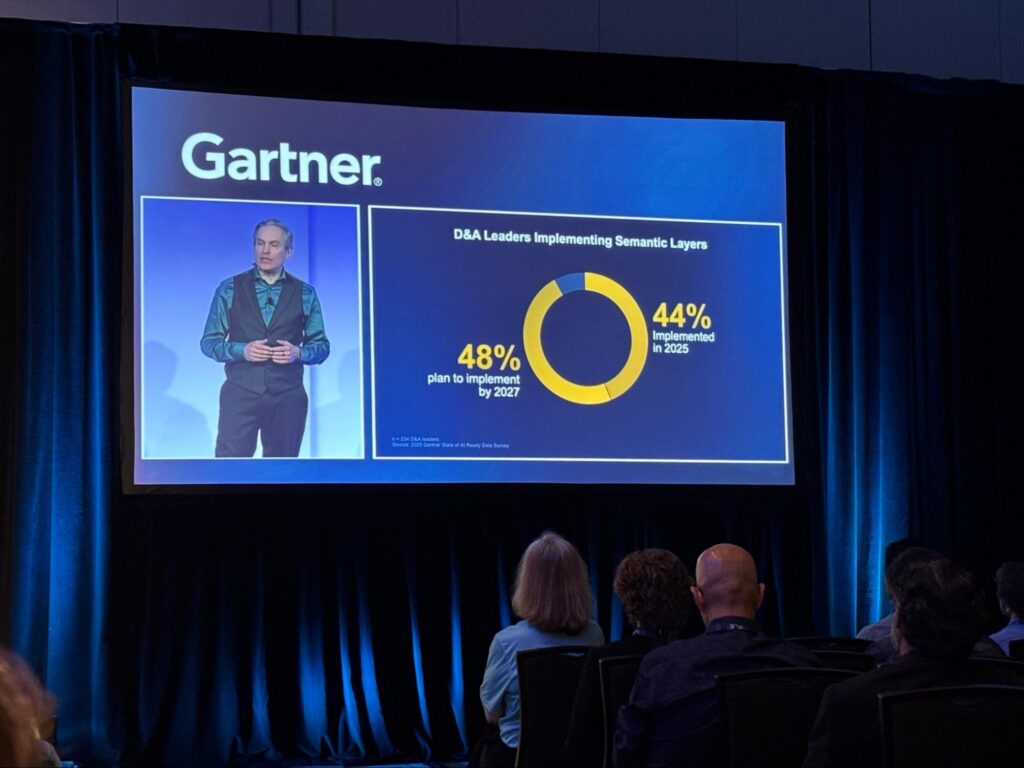
2. Semantic Layers and Context for AI Were Major Themes
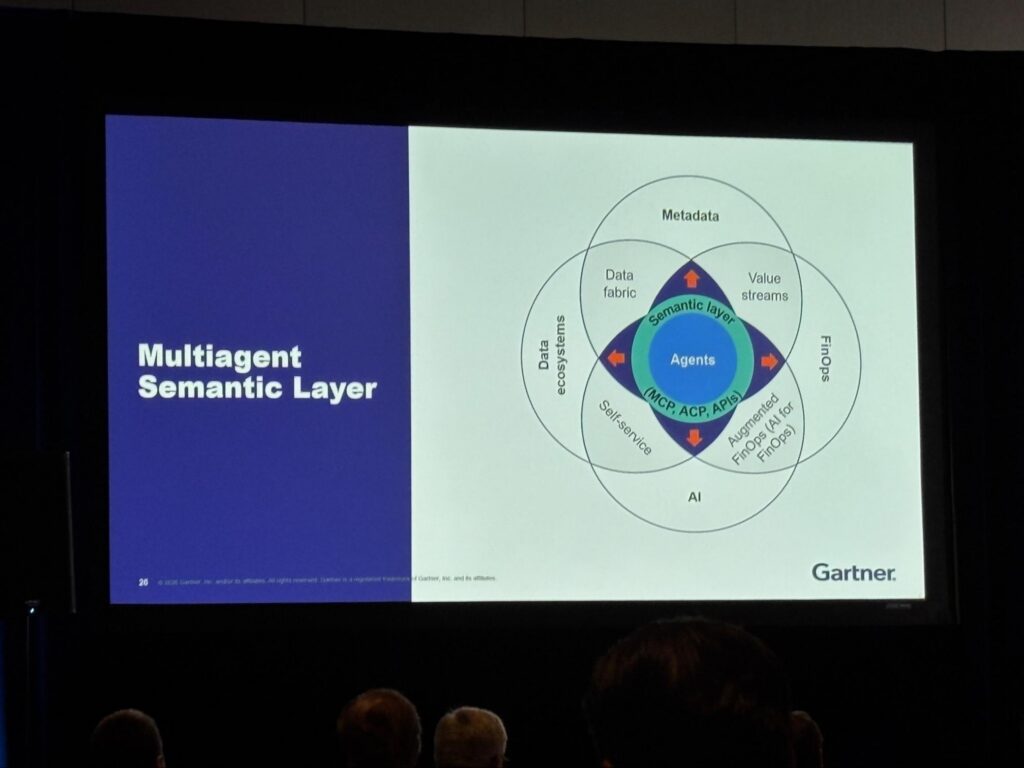
One of the most important themes across the summit was the recognition that AI requires business context.
Large language models are powerful, but they do not inherently understand the meaning of enterprise data.
For example, an AI system cannot determine on its own how a company defines revenue or an active customer. It cannot reliably interpret business hierarchies or metric calculations.
Without this context, AI systems will generate answers that sound reasonable but are factually incorrect.
This is where semantic layers become essential.
For decades, semantic layers were used primarily in BI environments. They translated technical database structures into business-friendly concepts.
Those same semantic definitions are now becoming the foundation for AI systems.
AI chatbots, copilots, and agents need access to trusted metric definitions. They need to understand business hierarchies, dataset relationships, and governance rules.
In other words, they need the same business semantics that BI tools rely on.
This creates an important opportunity for organizations that have already invested in semantic modeling. Those investments can now serve as the contextual foundation for AI.
Instead of letting AI query raw data directly, companies can route AI interactions through a semantic layer that enforces trusted business logic.
From AtScale’s perspective, this is exactly the architecture enterprises should pursue.
The semantic layer becomes the context engine for AI and the consistency layer for BI.
Dashboards consume metrics from the semantic layer. AI agents query those same semantic definitions when answering questions. Data platforms provide the governed data that feeds the models.
This architecture ensures that both humans and machines rely on the same business definitions.
As AI adoption accelerates, a unified semantic foundation will become one of the most important requirements for trusted analytics.
3. BI Is Not Going Away
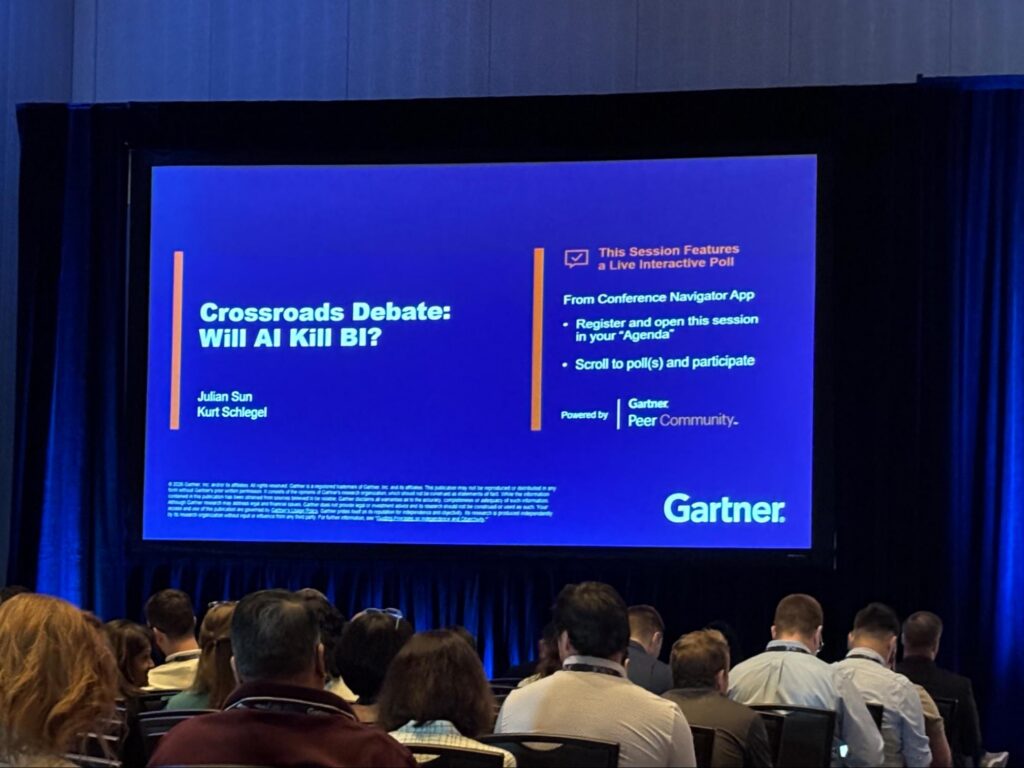
Another encouraging takeaway was Gartner’s acknowledgement that AI will not replace BI.
Several sessions addressed the question directly. One analyst debate even explored two opposing perspectives. One argument claimed AI would eventually subsume BI. The other argued that the two approaches would coexist.
The conclusion was that AI and BI will coexist.
Dashboards still serve an important role in analytics environments.
For example, many organizations have hundreds of users who monitor the same key metrics every day. A dashboard allows those users to quickly see performance trends and operational signals.
Replacing that experience with hundreds of individual chatbot queries would be inefficient.
Dashboards are excellent for monitoring, standard reporting, and shared operational visibility.
AI excels at exploration and ad hoc analysis. It allows users to ask follow-up questions and investigate unexpected results.
These two approaches complement each other.
The future of analytics is not AI replacing BI. It is AI-enhanced BI, where dashboards and conversational analytics operate together on top of a shared semantic foundation.
Navigating the AI River
Gartner’s rafting metaphor captured the moment well.
The AI river is powerful and fast-moving. Organizations cannot step out of the current. They have to learn how to navigate it.
Fortunately, many of the tools needed for this journey already exist. Investments in business semantics and analytics governance are becoming the foundation for trustworthy AI.
The companies that succeed will be those that build strong semantic foundations, provide context for AI systems, and combine the efficiency of BI with the flexibility of AI.
Those organizations will not abandon traditional analytics. They will extend it.
And that will allow them to steer their raft safely through the river of AI.
Looking for practical guidance on how enterprises are operationalizing context for AI? Register for the Semantic Layer Summit, a FREE, virtual event on May 20, 2026 for data and analytics leaders focused on agentic analytics and conversational BI.