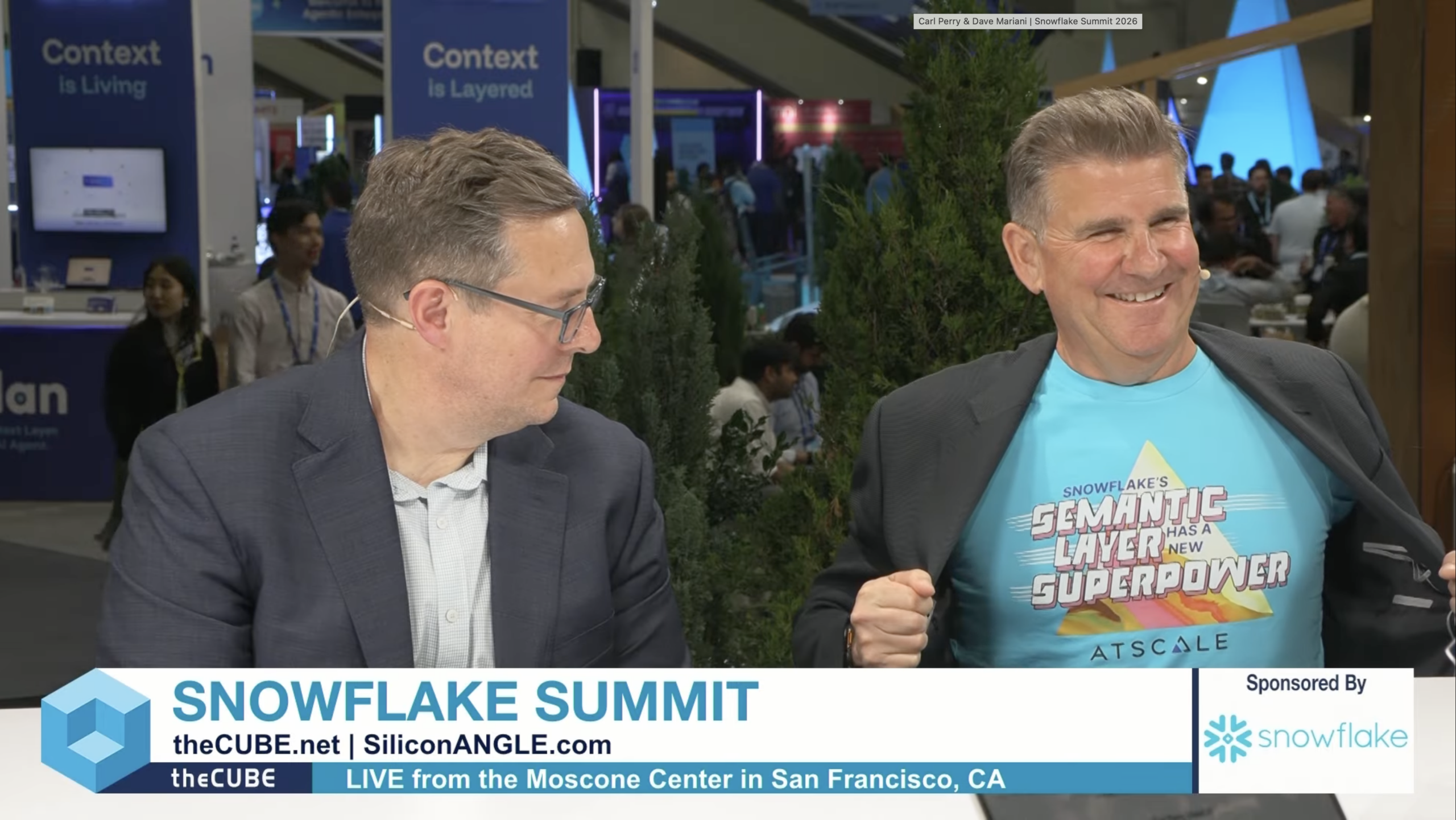
AtScale’s Dave Mariani and Snowflake’s Carl Perry on why governed semantics, not a smarter LLM, is what makes AI agents trustworthy.
For years, business intelligence ran on a human workaround. When two reports disagreed about “revenue,” a trained BI analyst noticed. They caught the mismatch, asked around, and reconciled the numbers. Process and people papered over the cracks in the data underneath.
AI doesn’t do that. AI is headless. It runs autonomously, without a person in the loop to pause and sanity-check the numbers. It won’t slow down the way a human analyst used to, asking around before trusting a figure. It fires off thousands of questions and acts on the answers at machine speed.
At Snowflake Summit 2026, AtScale CTO Dave Mariani made the point in a theCUBE interview with Snowflake’s Carl Perry. In BI, he said, humans and processes could mask the confusion and inconsistencies. Put headless agents on that same data, and the workaround collapses. Agents are extremely literal, as Rebecca Knight noted in the conversation. They take your data at its word. If the word is wrong, so is everything they do next.
This is why the semantic layer is back in the conversation. Companies aren’t returning to an old idea out of nostalgia. They need it to make the new one work.
Why the semantic model has to move
Perry traced how it happened. When self-service BI took off, companies built a model above the data and stopped worrying about the fragmentation below it. “The reality is the data underlying it doesn’t have that cohesion, doesn’t have that description,” he said. That is how an organization ends up with a handful of enterprise data models that look cohesive on the surface, while the data beneath them shares none. The consistency lived in the BI tool, not in the data.
That arrangement breaks the moment agents enter the picture. Agents don’t live inside a BI tool. They run autonomously, with the data residing where they drive workflows on their own. So the model has to move down next to the data, so that agents and BI tools return the same answer instead of drifting apart. A definition that exists only within one dashboard is invisible to an agent acting elsewhere.
Let AI be creative, not with your definitions
Mariani described the balance this way. You want your LLM to be creative. It’s a research assistant, and exploration is the point. What you do not want is for it to get creative with the definitions of revenue, customers, or churn. Those numbers mean one thing, and the business has already decided what.
The answer is to pair two different engines. Let the probabilistic LLM explore and cogitate. Anchor it to a deterministic semantic query engine that returns one governed answer every time. Put those together, Mariani said, and it’s beautiful. The LLM retains its creativity. The numbers stay correct and consistent.
The proof is starting to pile up. Anthropic’s own team reported that its internal analytics went from roughly 21% accuracy to 95% once a semantic layer sat between the LLM and the data. The fix wasn’t a smarter LLM. It was governed semantics.
Governance, from brake to gas pedal
The most striking turn in the conversation was about governance. David Vellante, Co-Founder and Chief Analyst at theCUBE Research, called it: governance used to be a blocker, and now it’s an accelerant. Perry agreed without hesitation.
Here’s the logic. Lock everything down, and people route around you. That’s how shadow AI takes hold, because the enterprise won’t give the people who need to do the work access to the data. Mariani argued for the opposite default. Open things up, and build a governance layer you trust enough to keep data out of the wrong hands. With headless agents in the mix, you cannot skip that step. You need a control plane, and the semantic layer is where it lives. Governance is what makes opening your data safe, which is what lets agents move fast in the first place.
What Snowflake and AtScale shipped
The interview also carried hard news: Snowflake Semantic Views for XMLA Endpoints, powered by AtScale. One DDL statement turns it on inside Snowflake. From there, your Snowflake semantic views connect live to Excel and Power BI, with no data movement and no duplicated logic. You can watch it work in this short demo.
Mariani’s prediction was about reach. There are roughly a billion Excel users, and most of them are locked out of warehouse data today because they can’t run queries against it. Hand them a live connection through the tool already on their desktop, and analytics opens up to people who never touched Tableau or Power BI. He’s watched it happen before, and called the AI version of that same democratization “times 10.”
Where this leaves the dashboard
Dashboards aren’t dead, but many of their uses are. The center of gravity is shifting from static reports you share to questions anyone can ask, with an agent that finds the answer. That only works if the agent and the analyst draw from the same governed definitions.
Agents are literal. Give them data that means one thing: defined once, governed everywhere. That’s the job of the semantic layer, and it’s why the category that AtScale started 14 years ago now looks like infrastructure for the agentic era.
For the deeper economics, see the Tier 1 bank benchmark on AI compute on the warehouse, and for the architecture trade-offs, the whitepaper on enterprise semantics for Power BI.


SHARE
Guide: How to Choose a Semantic Layer