Scaling AI efficiently comes down to one architectural choice: put a semantic layer, powered by a compute engine like AtScale’s ACE, in front of your warehouse so every query, from a dashboard or a GenAI copilot, gets rewritten, cached, and optimized before it ever hits the database. Enterprises that skip this step pay for it twice: in latency, and in runaway compute costs. Here’s why, and what the data shows.
I’ve been building data systems long enough to see the same problem repeat itself. Each wave of analytics promises speed and simplicity. Self-service BI promised freedom from IT. Cloud warehouses promised infinite scale. Now GenAI promises conversational, real-time access to data. Each wave delivers some value, but each also exposes architectural deficiencies.
The question I hear a lot from data leaders today is simple: How do you scale AI analytics so they’re both fast and cost-efficient?
The 2025 GigaOm Semantic Layer Radar Report named AtScale the Leader and Fast Mover for delivering sub-second query performance while optimizing warehouse costs. That recognition matters because performance and cost are no longer separate problems. They are highly related and correlated.
Why Dashboards and AI Queries Break Down
In many enterprises, as data continues to grow at an exponential rate, dashboards that once loaded in a few seconds now take minutes. Business teams across the organization define the same metric in varying ways, resulting in ongoing reconciliation and destroying trust in data. AI makes these problems worse. Large language models don’t necessarily care about efficient SQL. I’ve seen GenAI-generated queries that scan entire fact tables without filters, generate five layers of subqueries for simple aggregations, or create Cartesian joins that consume excessive compute resources. One GenAI query can cost as much as hundreds of dashboard queries. Without an optimization layer, enterprises face a bad tradeoff: accept latency that kills decision-making, or overspend massively on compute to brute-force results.

A Semantic Layer as a Performance Engine
Semantic layers make data more “business-friendly.” But that’s just the beginning. Underneath, a modern semantic layer also serves as a performance optimization engine.
At AtScale, our semantic engine intercepts every request, whether it comes from Tableau, Power BI, Excel, a GenAI copilot, or an API, and rewrites it for efficient execution. It doesn’t just pass SQL along. It actively optimizes. It recognizes query patterns and automatically builds aggregates. It tunes for workload shifts and seasonal usage. It anticipates likely queries through predictive caching. It pushes down optimized instructions to the underlying warehouse.
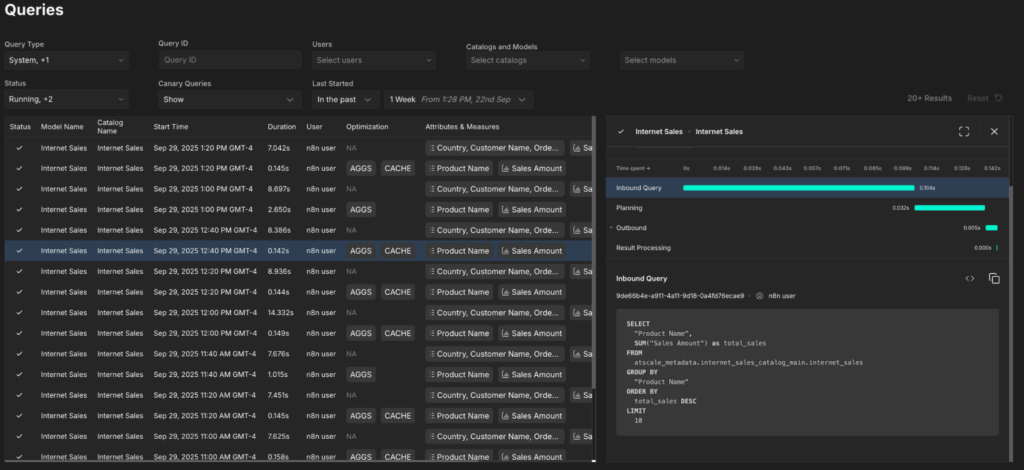
The result is sub-second query performance across billions of rows without duplicating data or creating brittle cubes.
The Cost Efficiency Equation
Every cloud query carries a cost. Multiply that by thousands of AI queries, and the financial impact becomes just as critical as speed.
Traditional optimization techniques such as cubes, materialized views, and denormalized tables are expensive to build and maintain. Worse, they multiply storage costs by duplicating the same data in multiple forms.
Semantic layers take the opposite approach. Semantic models eliminate dashboard redundancy. Query rewriting reduces computational complexity. Aggregate awareness avoids brute-force table scans. Caching eliminates repeated warehouse hits.
Performance isn’t purchased with more compute. It’s built into the architecture. In one production benchmark, putting AtScale’s compute engine, ACE (AI Computation Engine), in front of the warehouse cut AI query compute by more than 21,000x and cost by 99.995%, eliminating a bank’s roughly $9 million-a-year ‘rediscovery tax’ from AI agents re-deriving the same answers again and again.
Proof in the Real World
This isn’t theory. Enterprises across industries are already proving it works.
Home Improvement Retailer
One of North America’s largest home improvement chains migrated to BigQuery but still struggled with inconsistent metrics, outdated OLAP cubes, and limited self-service. With AtScale’s semantic layer, they unified business logic, delivered governed metrics directly into Excel and dashboards, and embedded natural language querying. Today, sub-second queries run across terabytes of retail data, supporting merchandising, finance, and operations at enterprise scale.
Bluemercury
A luxury beauty retailer faced constant disputes over metrics. Finance, marketing, and operations all defined sales and margin differently. By centralizing definitions in AtScale’s semantic layer and directly connecting Power BI and Tableau, Bluemercury eliminated conflicting analytics and unlocked governed self-service analytics. The same foundation now supports AI initiatives, giving GenAI copilots consistent, governed data to act upon.
TELUS
Canada’s telecom giant needed to analyze performance data from over 200,000 wireless cell towers across multiple vendors. Each vendor had its own standards, making consistent reporting nearly impossible. TELUS implemented AtScale to standardize KPIs across vendors and network generations. Engineers analyze data with Python, business users with BI tools, all against the same semantic layer. They’re now extending it further with Semantic Modeling Language (SML) to version models as code and scale analytics into new domains.
Three different industries. Three different problems. One solution: a semantic layer that turns performance and cost efficiency into architectural defaults.
GigaOm’s Take
This year’s recognition carries even more weight because the GigaOm evaluation itself has matured. Previously, semantic layers were covered in a Sonar Report, which assessed emerging, cutting-edge technologies. In 2025, GigaOm elevated the category into its Radar Report, which evaluates established, mission-critical platforms. That transition signals how the semantic layer has shifted from “promising innovation” to mandatory enterprise infrastructure.
The Radar highlights how the market has evolved: previously up-and-coming vendors have matured their offerings, while incumbents have been forced to invest in semantic capabilities to address customer demand. Analysts now evaluate semantic layers against the same checklists that technical teams already use: workload compatibility, broad tool connectivity, scalability, and governance.
The report highlighted exactly these strengths in AtScale: support for diverse workloads, governance that enforces consistency, and seamless integration across ecosystems. GigaOm recognized that a semantic layer isn’t just a convenience. It’s becoming the only sustainable way to control performance and cost at scale, mainly as AI drives new query volumes and complexity into everyday workflows.
Enterprises don’t adopt semantic layers because they’re trendy. They adopt them because, without them, performance bottlenecks and runaway costs make AI and BI untenable. But when done right, the advantages compound: dashboards run instantly, AI copilots deliver governed answers in real time, and costs remain predictable. That’s the competitive edge semantic layers enable, and it’s why GigaOm named AtScale both the Leader and a Fast Mover in the 2025 Radar.
See It for Yourself: Interactive Demo
To see how this works in practice, try our Optimize Cloud Costs and Performance interactive demo.
You’ll see how AtScale rewrites inefficient queries into optimized ones, uses aggregates to cut compute usage, and maintains sub-second responses without data duplication.
The demo shows what happens behind the scenes when the semantic layer reshapes query execution. It’s the same optimization engine our customers are running in production.
Take Action
Try the interactive demo to explore performance and cost optimization in action.
Download the 2025 GigaOm Semantic Layer Radar Report to benchmark AtScale against other platforms.
Request a live demo to watch your own workloads optimized in real time.
In enterprise AI, every query carries a cost. A semantic layer ensures those queries are both fast and efficient. That’s how you scale AI without breaking the bank.
It intercepts every query, whether from Tableau, Power BI, Excel, or a GenAI copilot, and rewrites it for efficient execution: building aggregates automatically, tuning for workload patterns, predictive caching, and pushing optimized instructions down to the warehouse.
Large language models don’t optimize for efficient SQL. They can generate queries that scan entire fact tables without filters, stack multiple layers of subqueries, or create expensive Cartesian joins, so a single GenAI query can cost as much as hundreds of dashboard queries.
The 2025 GigaOm Semantic Layer Radar Report named AtScale the Leader and Fast Mover for sub-second query performance and warehouse cost optimization, and enterprises like a major home improvement retailer, Bluemercury, and TELUS have used AtScale’s semantic layer to cut query costs and unify governed metrics across AI and BI workloads in production.
Cubes, materialized views, and denormalized tables are expensive to build, maintain, and duplicate. A semantic layer instead eliminates dashboard redundancy, rewrites queries to cut computational complexity, applies aggregate awareness to avoid table scans, and caches to eliminate repeated warehouse hits, without duplicating data.
It’s called ACE (AI Computation Engine). It intercepts every query regardless of source and automatically builds aggregates, applies predictive caching, and pushes optimized instructions to the warehouse, the same architecture that delivered a 21,000x+ compute reduction in a production benchmark.


SHARE
ANALYST REPORT