AI-ASSISTED SEMANTIC MODELING
What is AI-Assisted Semantic Modeling?
AtScale CoModel is AI-assisted semantic modeling. It reads your database schemas, dashboards, spreadsheets, catalogs and docs, drafts the model in SML (AtScale’s open-source, YAML-based modeling language), and works with semantic modelers and data engineers to get calculations right.

THE PROBLEM
A hand-built semantic model is a project that never ends.
It usually takes a small weeks to build semantic models by hand, one table at a time. Then the business moves on: product lines get renamed, regions split, and finance changes how it recognizes revenue. Each change means more hand edits, and until someone makes them, AI tools keep answering from the old definitions. An agent running a thousand queries a day won’t notice.
HOW MODELING WORKS
CoModel turns the context you already have into metrics ACE can compute.
Design Center and CoModel start from what you already have: BI dashboards, warehouse schemas, catalogs, documentation and models you’ve built before. CoModel, in private preview, proposes metrics and relationships, and you approve each change. The approved model is saved as SML in your Git repository, and when it deploys, ACE compiles it into the calculations behind every answer.
Human in the loop
A data engineer sets the scope and approves everything that ships.
Context in
Data warehouses
Data catalogs
Ontologies
Documentation
Models you already built
Modeling
By hand
Design Center canvas
and SML editor
With AI · CoModel*
Agents read the schema, query history and catalog, then draft the model
Semantic model out
Metrics and dimensions
SML in your Git repo
Read by Ava
Computed by ACE
The model improves with use. Approvals, corrections and real queries shape the next change.
*CoModel is coming this fall.
MODEL BY HAND, TODAY
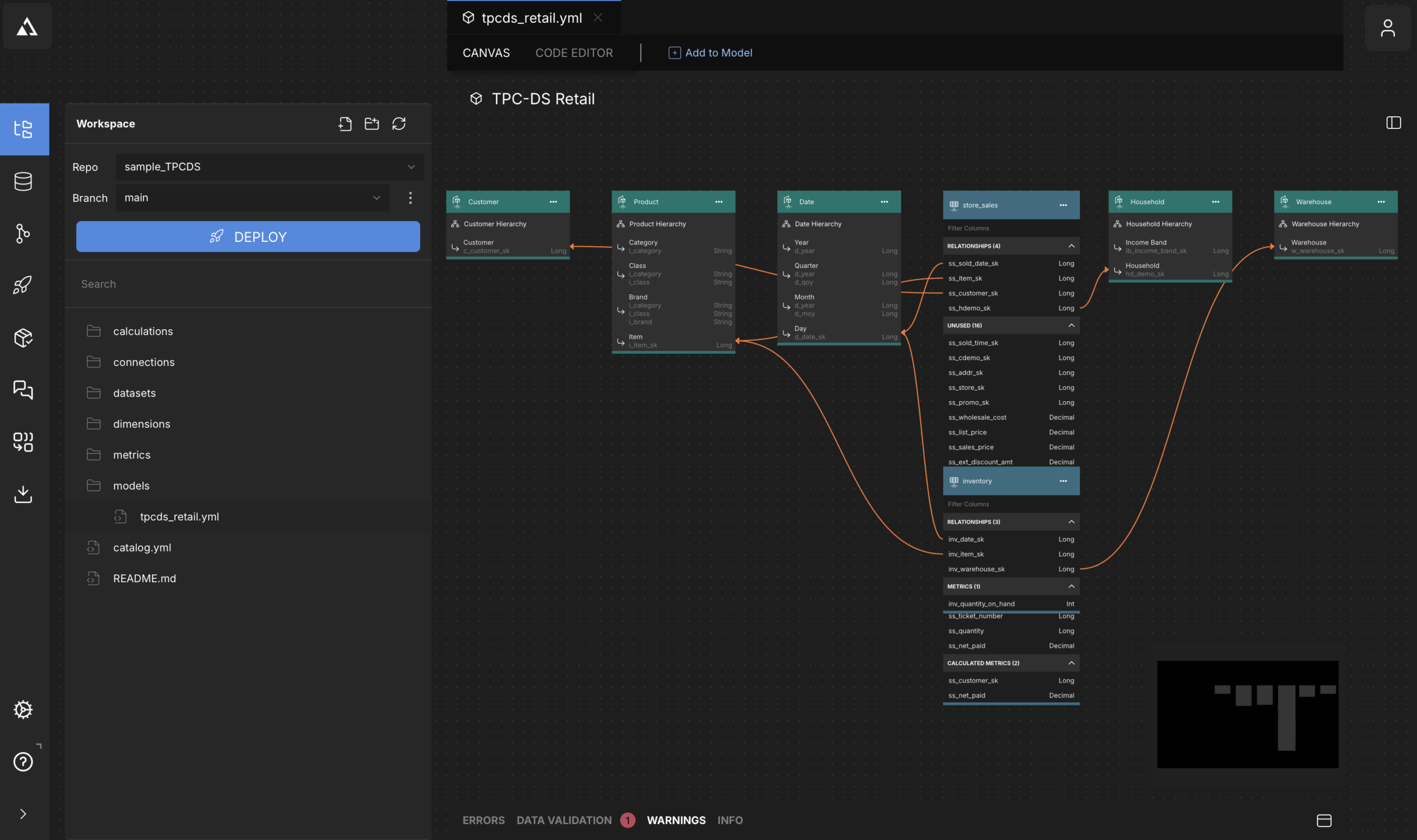
Design Center gives modelers a visual canvas and a code editor.
Modelers drag fact tables and dimensions onto a canvas, draw the relationships and define each metric. The text editor shows the same model as SML, so engineers can edit it as code. A finished model goes through a pull request and deploys from dev to QA to production.
Model with AI, this fall
CoModel agents draft the model for your team to review.
CoModel is AI-assisted semantic modeling that runs inside a coding agent such as Claude Code, with a data engineer directing the work. Its agents gather the context you already have, from BI dashboards and Databricks ontologies to documents and warehouse schemas, and draft metrics and dimensions in SML. They ask about the business decisions they can’t make on their own and submit each change as an SML diff for you to approve.
THE PROOF
CoModel built BIRD-Interact’s models in hours, and AI got twice as accurate.
For BIRD-Interact, the public benchmark built from realistic enterprise questions, a CoModel preview modeled every database behind the benchmark in a couple of hours. Engineers then tuned the models, and with them, an LLM got twice as many answers right in preliminary runs.
FAQs
How do I know who changed a metric definition, and when?
Every definition lives in your repository in SML, a text format, so a change has an author, a date, a diff, and an undo. Your git history becomes the audit trail: no more Thursday-afternoon edits with no record of who touched what or why the board deck suddenly disagrees with the dashboard.
Can an AI agent see data a person isn't allowed to see?
No. The query runs as the person asking, so the row and column rules already in your warehouse apply to the agent too; there’s no separate permission system for AI to slip through. Without that, an agent pointed at a semantic model can reach every metric in it, including ones an analyst couldn’t open on their own, which is exactly the risk Governance closes.
What's a "blast radius," and how do I see one before a change ships?
A blast radius is the list of metrics and reports a definition change actually moves. Before a change merges, AtScale computes the old definition beside the new one and names what shifts, so a one-line edit to how revenue is defined shows its four-report impact in the pull request instead of in a board meeting after the fact.
Does shipping metric changes through review slow the team down?
No more than any other production change would. A change to a definition arrives as a pull request, gets reviewed with its blast radius attached, and promotes or reverts the way code does. That review step is what catches a breaking change before it ships, not after finance notices the board deck is wrong.
How does Governance relate to ACE, Ava, CoModel, and Canary?
ACE computes the metric, Ava works out which metric a question means, CoModel drafts and maintains the model, and Canary scores the answers (Canary coming this fall). Those four decide what the answer is. Governance decides whether it ships: which version of a definition is live, who approved it, and which rows the person asking is allowed to see.