Self-service BI stalled at about 25% of employees for more than a decade because the numbers didn’t agree, not because the tools were hard to use. AI chat makes asking easy again, but if each chat works out its own definition of revenue, every answer becomes a new “spreadmart” (a term from the early 2000s BI era for a spreadsheet or desktop database a team built outside the official BI system, with its own definition).
Salesforce found that 89% of data and analytics leaders with AI in production have already seen inaccurate or misleading outputs. Self-service analytics with AI works when every tool answers from one set of shared business definitions, so two people asking the same question get the same number.
Self-service BI stalled because teams couldn’t agree on definitions, so fix definition mismatches before you add tools.
AI chat brings the same risk back at a faster pace. Workers at more than 90% of companies use personal AI tools (MIT Media Labs NANDA, 2025), and each chat can produce a private number nobody else can check.
Judge an AI analytics rollout by whether answers agree, not by how many people use it. Two people asking the same question should get the same number.
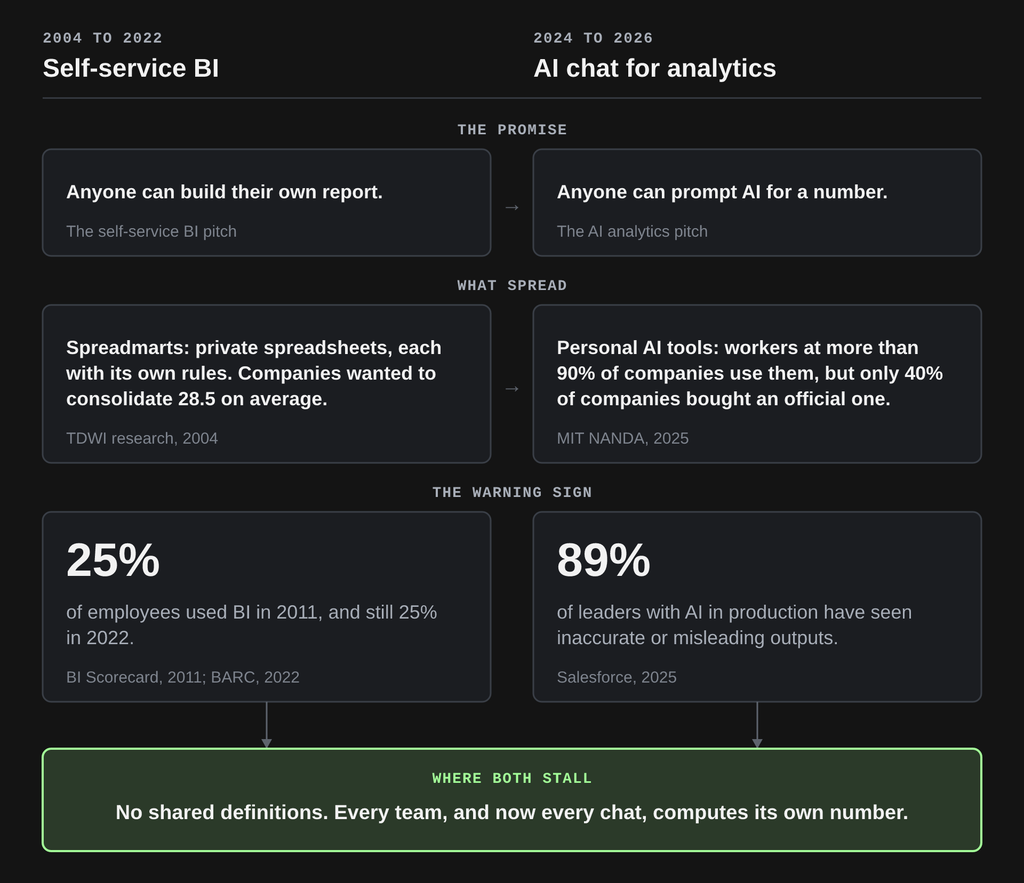
“Anyone can ask a question and get a number.” That’s how AI chat for analytics is being sold today. It’s also how self-service BI was sold fifteen years ago, and that push stalled at about a quarter of employees for more than a decade (InformationWeek, 2011; BARC, 2022).
“Anyone can ask a question and get a number.” That’s how AI chat for analytics is being sold today. It’s also how self-service BI was sold fifteen years ago, and that push stalled at about a quarter of employees for more than a decade (InformationWeek, 2011; BARC, 2022).
The tools weren’t the problem then, and they aren’t the problem now. Definitions were. Every team built its own spreadsheet with its own rule for revenue, and nobody trusted the other team’s number. BI teams spent the 2000s stamping out “spreadmarts”, the private spreadsheets where each team kept its own definition of revenue, and AI chat is resurrecting some of those same challenges.
Today the spreadsheet is a chat window. Workers at more than 90% of companies use personal AI tools for work, while only 40% of companies have bought an official LLM subscription (MIT NANDA, 2025). Self-service analytics with AI can repeat that history if it computes a fresh answer for every question. Then every AI chat answer becomes a new spreadmart: a private calculation with its own definitions that nobody else can check.
Why did self-service analytics for BI stall?
Self-service BI stalled because the numbers didn’t agree, not because the tools were hard to use. Wayne Eckerson coined “spreadmart” for “the renegade spreadsheets and desktop databases wreaking havoc on organizations.” By 2004, TDWI research found organizations wanted to consolidate an average of 28.5 of them (Eckerson, 2004).
Vendors answered with easier tools, and adoption stayed put. The BI Scorecard Successful BI Survey put adoption at 25% of employees in 2011 and called it “stubbornly flat” (InformationWeek, 2011). In 2022, a study from BARC and Eckerson Group still found an average of 25% (BARC, 2022). That’s eleven years of better interfaces operating with the same limitations.
The root cause was trust. Picture finance, sales, and marketing walking into the same meeting with three revenue numbers. The meeting devolves into an argument about whose spreadsheet is right. Afterward, people stop asking the tool and go back to the analyst they trust, which is the habit self-service was supposed to end. For a data leader charged with consolidating a fragmented analytics infrastructure, the lesson is to fix the definition mismatches first and the tools second.
Is conversational AI the answer to self-service analytics?
Conversational AI is the answer only if it answers from shared definitions. Otherwise each chat works out its own version of “revenue” in isolation. Businesses are recreating the spreadmart, now at chat speed.
Natural-language prompts democratize the ability to ask questions about data. But an easier interface was the fix last time, too. Dave Mariani, AtScale’s founder and CTO, made the point in his post on building trust in conversational BI. As the post puts it, natural language queries, agents, and chatbots “make this lack of trust or lack of consistency of access to your data even worse.
The early numbers back this up, and they come from leaders who already have AI in production. Salesforce’s 2025 State of Data and Analytics research found that 89% of data and analytics leaders with AI in production have seen inaccurate or misleading outputs. In the same research, 42% lacked full confidence in the accuracy of their AI outputs.
Those leaders also estimated that 26% of their organization’s data is untrustworthy.
Scale has also become an issue. In a Gartner survey fielded in early 2026, only 22% of organizations had scaled AI across multiple business units. While this represents organizations and not employees, the shape is familiar: plenty of pilots, slow adoption.
Why do AI answers erode trust in data?
AI answers erode trust because one confidently wrong number ends the relationship, and the company still owns the answer. Dave put it this way on the first episode of The AI Accuracy Files:
“As soon as somebody gets an answer that’s confidently wrong, that’s going be the last time they ever ask.”
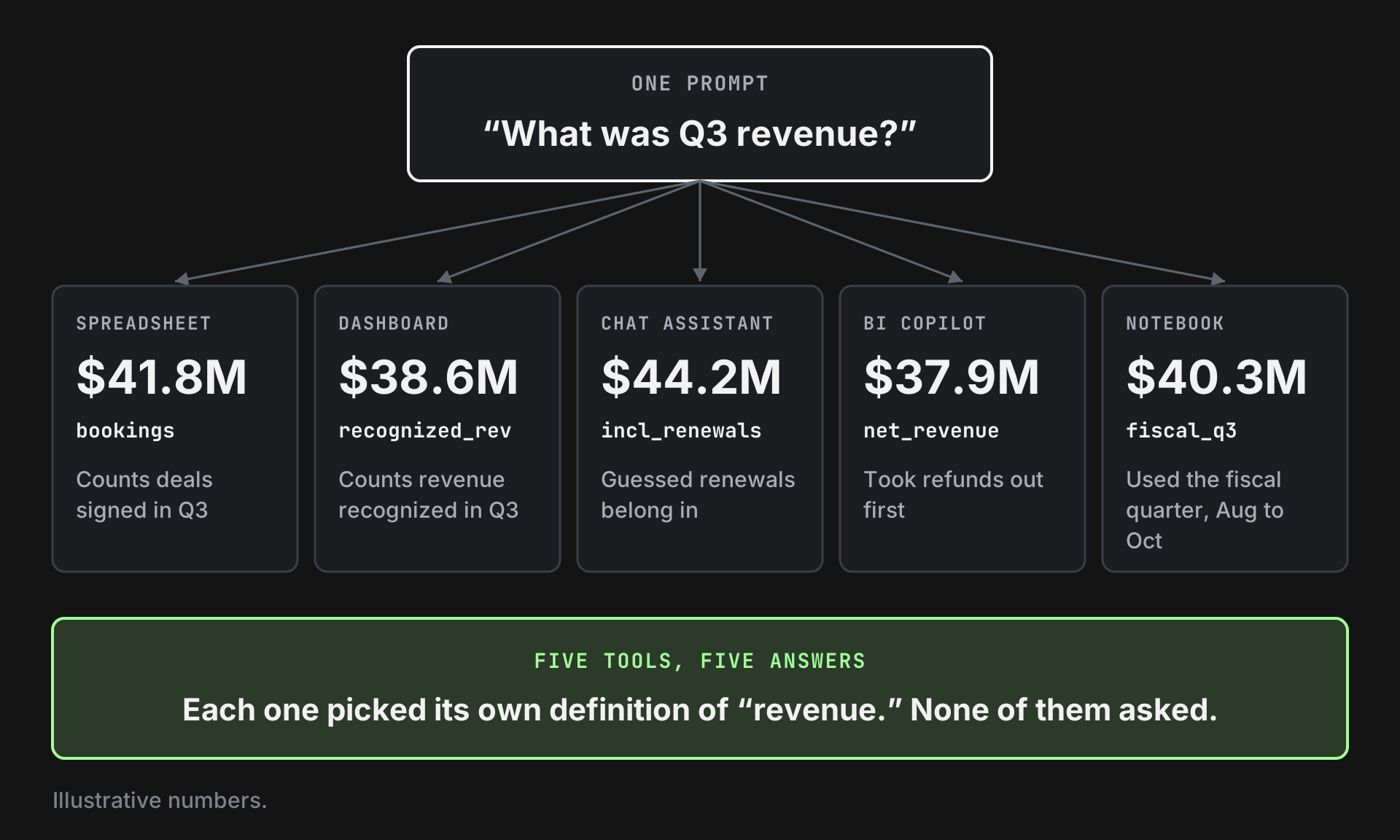
There’s another kind of sprawl. A copilot in every BI tool means a separate set of guesses in every tool. Ask the same question in a spreadsheet, a dashboard, and a chat assistant, and you can get three answers. Most of those wrong answers start as a guess: the tool doesn’t know which “revenue” you mean, so it picks one and answers with confidence.
How do you make self-service analytics work with AI?
Put the business definitions in one layer every tool reads, and let the AI ask when a question is unclear. That shared layer is what self-service BI was missing the first time, and AtScale ACE, the AI Computation Engine, computes every answer from it the same way, whichever tool asks.
AI on its own still struggles with business questions. On the public BIRD-Interact leaderboard, which tests models on 600 tasks built around vague questions and messy data, the top verified entry scored 38.0% (as of September 16, 2026). Most mistakes aren’t syntax errors, but guesses about what a business term means.
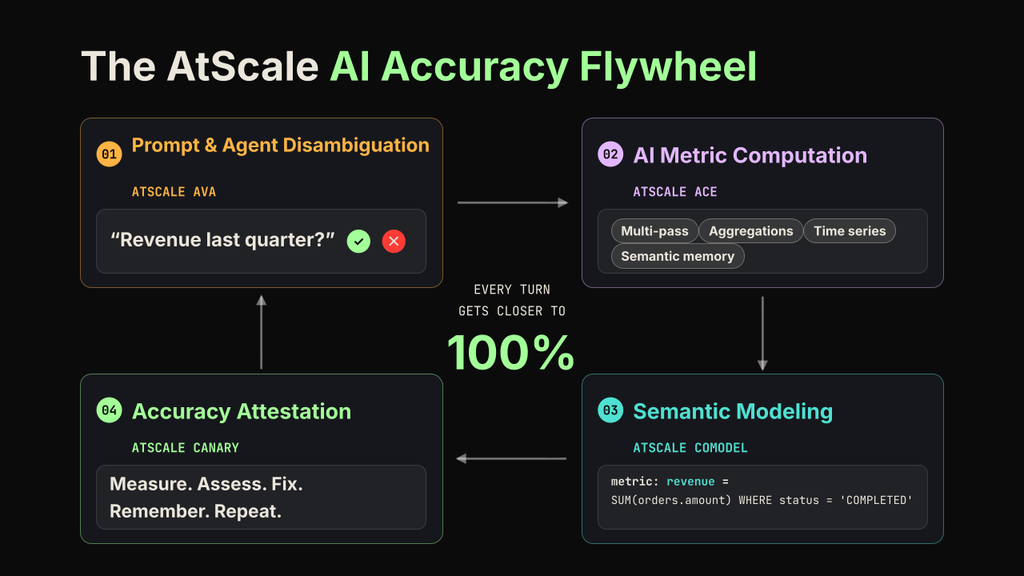
That’s the gap that AtScale’s Ava (Ask, Verify, Answer), is designed to close. Ava notices when a question could mean two things and asks before anything is computed, and drives action through the AI accuracy flywheel.
If a sales leader asks for “pipeline this quarter,” that could mean opportunities created this quarter, or everything expected to close within this quarter. Ava will ask to clarify, then answer from the same shared definitions everyone else uses. The aim is one number, whether it’s asked in Claude, Copilot or Codex, by anyone in the business.
As Dave said in The AI Accuracy Files, “Anybody who can write a sentence can now be an analyst.” Shared definitions make that true for a whole company instead of one team at a time.
How should data leaders measure an AI analytics rollout?
Don’t judge an AI analytics rollout by how many people use it. BARC and Eckerson Group found that 92% of leaders saw BI usage rise over five years, driven mostly by embedded reports and off-license users (BARC, 2022). Over the same stretch, adoption sat at 25%. More people saw reports, but the share asking their own questions didn’t grow.
A chat rollout can post the same kind of numbers: thousands of questions a week and a dashboard full of usage charts. None of that tells you whether the answers are right, or if people trust them.
Judge the rollout by whether two people asking the same question get the same number. If they do, self-service finally scales. If they don’t, you’re building spreadmarts again, only faster than anyone managed in 2004. That’s the bar Ava is being built to clear.
Learn more about Ava here if enabling accurate self-service analytics with AI is a priority for your organization.