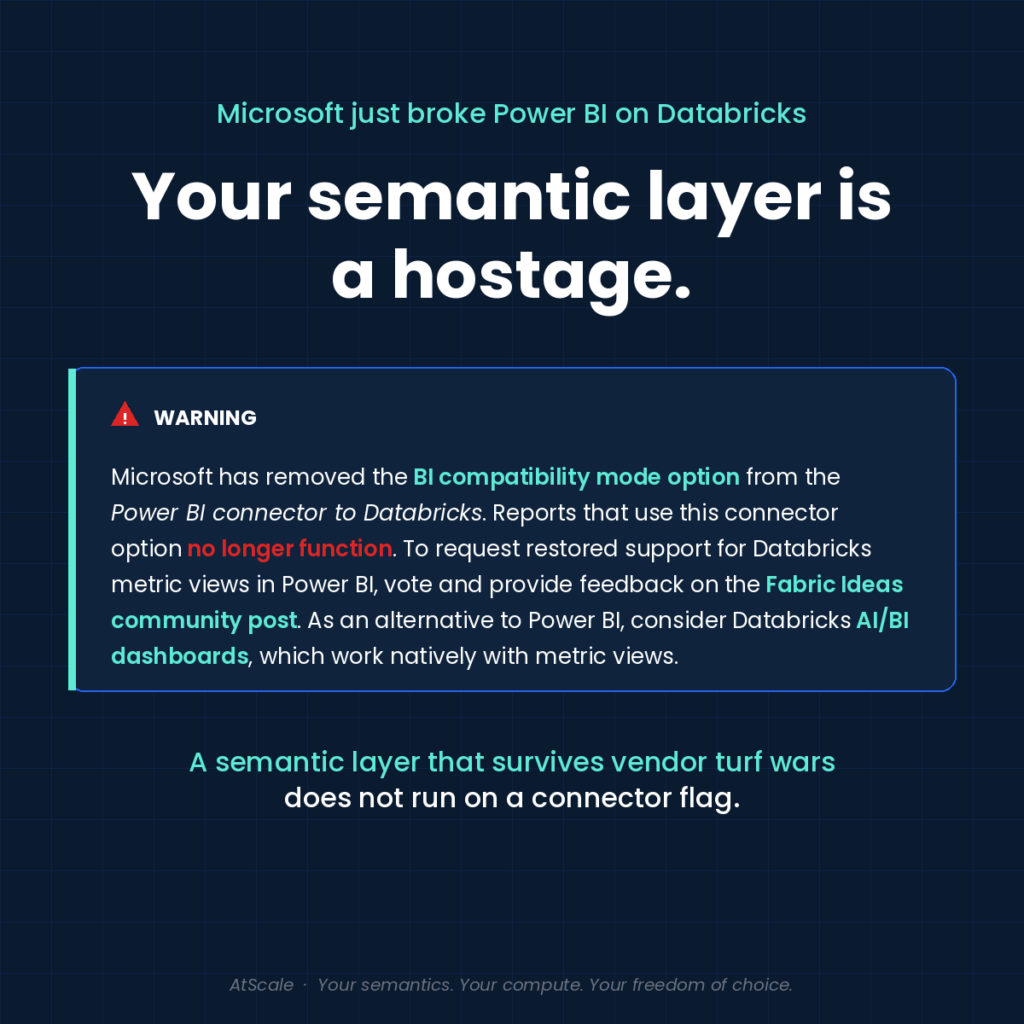
Microsoft made a small, deliberate change to the Power BI connector for Azure Databricks (release notes). The change looks technical, but it’s really a move to seize control of the semantic layer, where your company defines what revenue, customer, and pipeline actually mean.
That move started a cross-fire with Databricks, and customers are caught in the middle. No deprecation period. No migration path. Dashboards built on Unity Catalog Metric Views went dark across global enterprises overnight.
If a vendor can flip a setting and erase how your company defines revenue, you don’t own your numbers. They do.
The false choice: beg for a feature or migrate off of Power BI
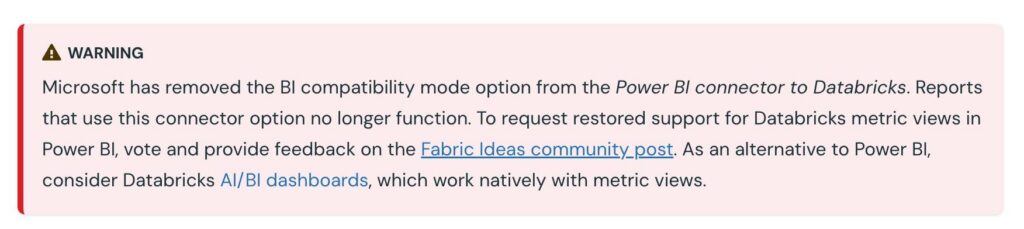
Microsoft’s guidance to affected customers? Ditch Power BI for AI/BI dashboards.
Databricks’s guidance? Go vote on a Microsoft community forum and hope they reverse it, or rip out Power BI for Databricks dashboards.
Beg for a feature to be reinstated or rip out Power BI. Neither is a good business solution. When your data platform vendor’s official answer to broken metrics is “go vote,” you don’t own your semantic layer. You’re collateral damage in a vendor cage match.
The fight isn’t about lakehouses. It’s about your numbers.
The easy read is Fabric versus Databricks fighting over the lakehouse. The real story is bigger. Every major vendor in this market wants to own your business definitions, the ones that decide what counts as revenue, what counts as a customer, and what counts as pipeline. Whoever owns those definitions owns the conversation in your boardroom, and they know it.
That’s why Microsoft killed the bridge to Databricks. It’s why every other platform is racing to lock metrics inside their own walls. Your semantics are the prize, and the vendors are willing to break your reporting to win it.
Why BI breakage matters more in the AI era
A broken dashboard gives a human the chance to spot an error and ask a question. AI agents don’t. They run on whatever definition is in front of them and produce confident answers either way. If your numbers don’t agree, your AI doesn’t agree, and nobody on your team will see it until a customer, a board member, or a regulator does.
Hand your semantics to a platform vendor and you’re betting your AI strategy on their roadmap. That’s a bad bet for the business, and the people on your AI team know it.
Own your semantics, or somebody else will
Every enterprise data architect and AI leader has a choice to make right now. The freedom to define your business once and use it everywhere, or let a platform vendor define it for you on their roadmap.
You can hand the keys to a platform vendor and live with what they ship. Or you can own the definitions yourself, govern them once, and let every tool, team, and AI agent ask the same question and get the same answer.
That’s what AtScale does (Power BI integration, AI lakehouse). We sit above the platforms and the BI tools so your semantics belong to you, and you keep the freedom to choose Power BI, Tableau, Excel, Snowflake, Databricks, or whatever comes next, without rebuilding what revenue means.
Define your business once. Use it everywhere. That’s freedom.