Every enterprise AI conversation eventually runs into the same wall. Someone pulls up the output from an agent or a natural language query, and someone else in the room says, “That number doesn’t look right.” The AI project doesn’t have an LLM problem. It has a context problem.
That was the argument at the center of the 2026 Semantic Layer Summit keynote: the reason most enterprise AI projects fail to deliver measurable business impact isn’t the quality of the LLM. It’s the absence of a governed, trusted business context behind the answer.
The problem isn’t the LLM. It’s the missing context.
When AI runs directly on raw data, it can’t generate business truth.
A schema doesn’t tell you how finance defines revenue. A table doesn’t tell you how a hierarchy should roll up. A column can’t tell you what time period is relevant to a given calculation, or which users are authorized to see the result broken out by territory. None of that context lives in the data itself. It lives in the semantic layer.
This is why three teams at the same company can ask the same question and get three different answers. The hallucination problem that enterprises keep diagnosing is, in most cases, a context problem.
The stakes are different now with AI. A disputed dashboard number wastes 20 minutes in a meeting. A flawed answer flowing into an agent or an autonomous workflow moves before anyone in the room can debate it.
AI did not change what enterprises require from data. It raised the cost of getting it wrong.
Five requirements for a semantic layer that can support enterprise AI
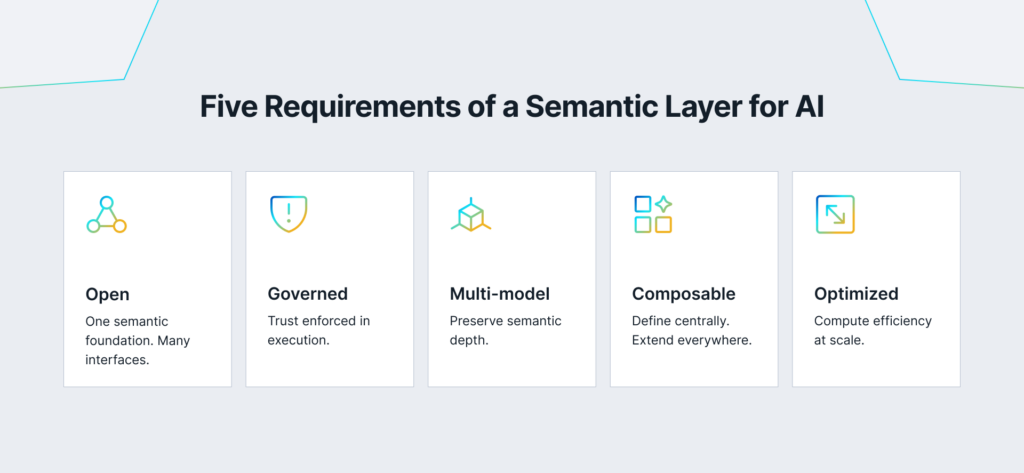
At the Summit, AtScale defined the standard that a semantic layer must meet to be ready for enterprise AI. Most semantic layer vendors in the market fall short of these requirements.
Open. Enterprises operate across many interfaces simultaneously: BI tools, spreadsheets, browser-based applications, and now AI agents. If every interface requires a separate translation of business logic, you create semantic silos. Open means one governed semantic model that serves every interface and every data platform without redefining the business for each one.
Governed. Governance cannot be bolted on after the answer appears. It has to be embedded in the execution path: the right answer for the right user with the right permissions, enforced consistently at query time across every interface. When AI agents are making tens of thousands of decisions a day and the “user” is not a human, access control and auditability must be built into the system.
Multi-model. Enterprises don’t run on flat tables alone. They run on dimensional models, hierarchies, time intelligence, complex calculations, and years of accumulated business meaning. A semantic layer that’s non-dimensional may look simple, but it loses the depth where enterprise AI matters most. Multi-model means the institutional knowledge built over the years survives modernization intact and is available to every interface and every agent.
Composable. The old pattern is duplication: one team defines a metric, another copies it, a third modifies it slightly, and eventually the organization ends up managing drift rather than meaning. Composable means shared business logic at the center, controlled extension where teams need it, and version-controlled change management across the system. That is how you scale semantic consistency without freezing teams in place.
Optimized. Every AI-driven question that hits an unguided warehouse triggers a full scan against base tables, repeated from scratch on every prompt. A production benchmark run by the commercial banking division of a global Tier 1 bank measured this directly: five representative queries cost $17.93 through the unguided path and $0.0008 through AtScale’s Adaptive Multi-Dimensional Computation Engine (ACE). That’s a 21,000x difference on real production workloads. The warehouse does a fraction of the work and the bill reflects what was actually computed, not what an agent had to rediscover.
If a semantic layer cannot satisfy all four of these requirements simultaneously, it is not ready to support enterprise AI in production.
What we announced at the Summit
The product roadmap we announced at SLS 2026 was organized directly around these five pillars. Luis Maldonado, who joined AtScale as Chief Product Officer from dbt Labs and AWS, walked through live demonstrations of each capability.
A new MCP server with model generation from Claude. The Open pillar led with the most visible new capability: an expanded AtScale MCP server that allows AI assistants to work directly with governed semantic layers. In the live demo, our research team used Claude Code to generate a fully dimensional model from a Snowflake connection, including semi-additive metrics like inventory (built as the last non-empty value, not a simple sum), time hierarchies, and validated SML output, all without manual modeling. The model was deployed and queryable by an AI agent in the same session. This is MCP becoming operational infrastructure.
Passthrough security and full auditability. On the Governance pillar, we demonstrated passthrough security: every query, whether it originates from Excel, Power BI, Claude, or any other client, carries the identity of the user or agent through to the data platform. At the query level, AtScale audits who asked, what they asked, and what the semantic engine sent downstream. At the warehouse level, the impersonated identity governs row-level and table-level access, as well as data masking. RBAC controls apply at the Git layer (which repos a developer can access, read/write access), the model layer (which data models a user can discover and query), and the data layer (which tables and columns a user can access). When an autonomous agent is operating at scale, this kind of full traceability is what makes AI trustworthy enough to act on.
Multi-model support across Excel and Power BI. The Multi-model demonstration addressed a real architectural problem: the tradeoff most organizations accept between tabular support and dimensional depth. Historically, choosing a tabular model meant Excel users lost multidimensional navigation; preserving multidimensional structure for Excel meant Power BI authors lost access to modern authoring capabilities like field parameters. We eliminated that tradeoff. Using the same model and the same governance definitions, Excel users get live multidimensional navigation, and Power BI report authors get the modern tooling they need. No rebuilds, no compromise. The semantic depth the organization spent years building is a compounding asset, not a migration liability.
Git-native hub-and-spoke composability via Design Center. The Composability demonstration showed what version-controlled semantic model governance looks like at enterprise scale. Using AtScale Design Center backed by GitHub, GitLab, or Azure DevOps, a retail organization’s shared library defines common semantic objects (customer, date, geography, product) as governed artifacts. Business domain teams in sales, supply chain, finance, and HR each manage their own semantic object repositories and reference the shared semantic object library via packages. A KPI like perfect order, which requires combining delivery, order, and shipment logic across multiple domains, can be composed across those models without duplicating definitions. Version control is first-class, not an afterthought. This architecture prevents semantic drift from compounding over time.
AI is now the primary driver for the semantic layer
Five years ago, almost no enterprise built its data strategy on the assumption that AI agents would run in production workflows. The enterprises struggling most with AI today are the ones that made technology decisions that assumed the future would look exactly like the present. They embedded their business logic in one vendor’s tooling.
Every new AI interface or tool your team wants to adopt now requires rebuilding the semantic foundation from scratch. That is the cost of a closed, platform-native approach to semantics.
The enterprises that built on an open, governed, composable semantic foundation are the ones that have absorbed the AI wave without starting over.
The question worth asking now is whether your semantic strategy is built for the tools you have today or for the business you intend to operate in the years ahead. Open, Governed, Multi-model, and Composable are the minimum bar for enterprise AI that can actually deliver business outcomes.
Watch the full keynote and all sessions from the 2026 Semantic Layer Summit on demand here.