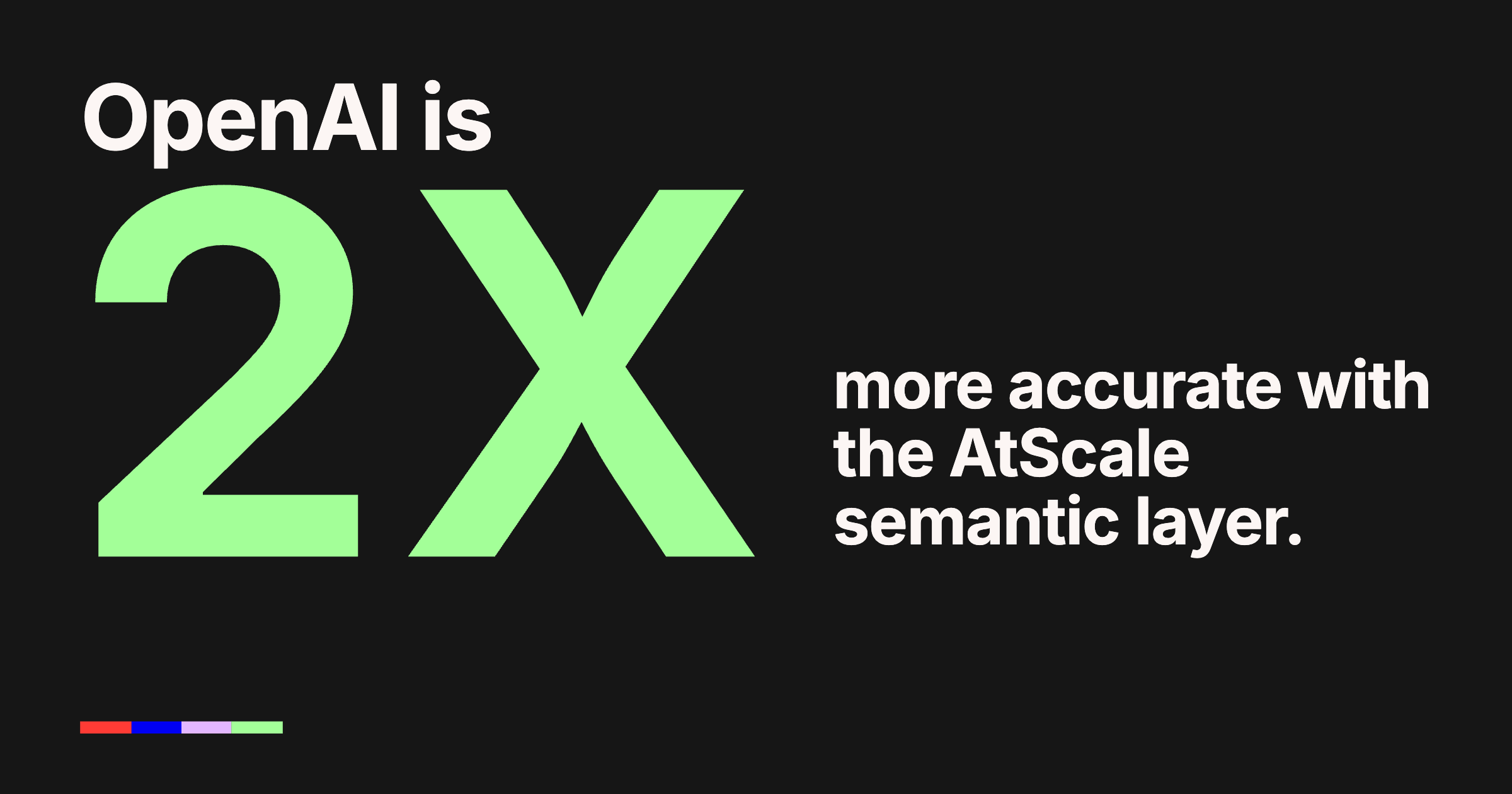
OpenAI has changed how people work. Enterprise teams use ChatGPT every day to draft, summarize, research, and write code.
Building enterprise applications on business data is a harder row to hoe. Ask Codex to build a customer churn dashboard and you’ll have working code in minutes. To show last quarter’s churn rate, though, the model has to decide which customers count, when a customer has left, and which dates to use. It guesses at each of those, and any one guess can change the number.
AtScale dramatically reduces those guesses. The AtScale semantic layer keeps every metric definition current and tested as your business changes, and the AtScale AI Computation Engine (ACE) computes each answer from the latest definition, so ChatGPT and Codex start from your company’s definition of churn instead of inventing one. With AtScale connected to ChatGPT and Codex, enterprises get a path to 100% accuracy.
THE NEWS
AtScale, a provider of the Universal Semantic Layer for enterprise AI and analytics, today announced that it has been named an OpenAI Select Partner within the OpenAI Partner Network.
The OpenAI Partner Network is a global program for partners to build, sell, and deliver AI solutions with OpenAI. It brings together partners with deep industry expertise, delivery capabilities, and customer relationships while equipping them with resources, enablement, and support to help enterprises adopt OpenAI frontier models and products and turn them into measurable impact.
AtScale now connects directly to ChatGPT and Codex, and our teams will work with OpenAI to help shared customers use those models for the metrics they report to their boards.
GPT-5 gets 2.4 times as many answers right with AtScale
We tested how much those guesses cost on BIRD-Interact, a public academic benchmark of 600 business questions across 22 PostgreSQL databases. Its prompts are vague, a simulated user pushes back, and a plausible but wrong number scores zero. We ran each model straight against the databases, then again with an AtScale semantic layer that software generated automatically.
THE NEWS AtScale, a provider of the Universal Semantic Layer for enterprise AI and analytics, today announced that it has been named an OpenAI Select Partner within the OpenAI Partner Network. The OpenAI Partner Network is a global program for partners to build, sell, and deliver AI solutions with OpenAI. It brings together partners with deep industry expertise, delivery capabilities, and customer relationships while equipping them with resources, enablement, and support to help enterprises adopt OpenAI frontier models and products and turn them into measurable impact.
AtScale now connects directly to ChatGPT and Codex, and our teams will work with OpenAI to help shared customers use those models for the metrics they report to their boards.
GPT-5 gets 2.4 times as many answers right with AtScale
We tested how much those guesses cost on BIRD-Interact, a public academic benchmark of 600 business questions across 22 PostgreSQL databases. Its prompts are vague, a simulated user pushes back, and a plausible but wrong number scores zero. We ran each model straight against the databases, then again with an AtScale semantic layer that software generated automatically.
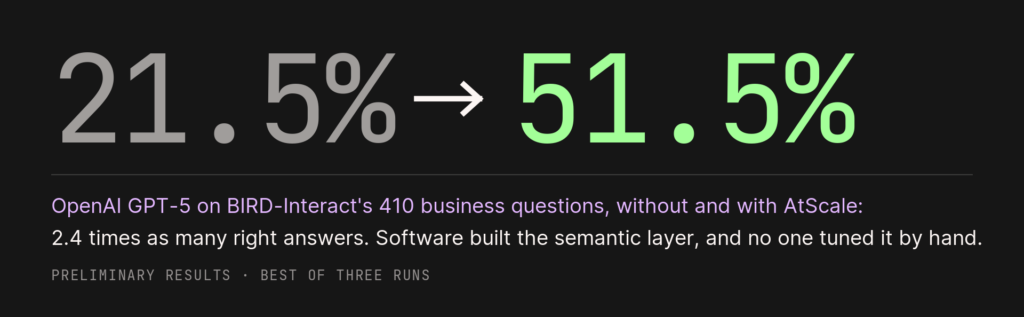
Every model we tested improved. On the 317 questions with a verifiable answer, the top-scoring model went from 46% to 93%. The weakest model with AtScale beat the strongest model without it, and cost per right answer fell about 21% on average, because AtScale answers repeat questions from aggregates and cache instead of making the model query the schema again.
Preliminary results, not yet verified by the BIRD team. GPT-5 figures are best of three runs. On all 410 business questions under the leaderboard protocol, the top-scoring model went from 25.9% to 56.6% (best of three; 50.2% on a cold first run). Methodology: atscale.com/bird.
At 93%, the top model still missed 23 questions, and our target is 100%. AtScale for AI works through those misses in a loop, with OpenAI’s models at the center:
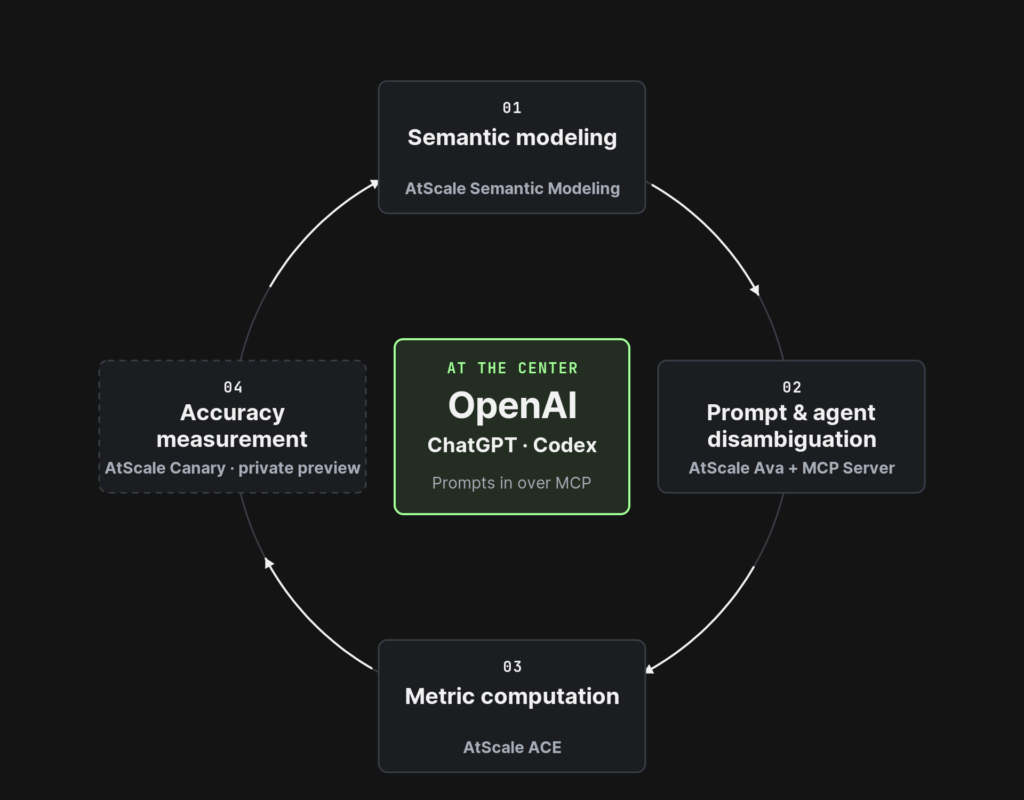
Every pass through the loop makes the semantic model more accurate and gives the company an accuracy score on its own questions. Ava and ACE are available today. CoModel and Canary are in private preview.
HSBC went from 65% to better than 99%
Compare the Cloud covered the result last week. As the outlet put it, “HSBC says that putting a semantic layer under its AI agents lifted accuracy on deterministic analytics from 65% to better than 99%, measured on a 10 TB table in Google Cloud.”
“In banking, an AI answer that’s almost right is still wrong.”
Dr. Kevin McLafferty, Head of Data & Analytics, HSBC
We want the same result for every ChatGPT and Codex application that reports a business metric.
How ChatGPT gets more accurate answers with AtScale
When someone asks ChatGPT a business question, AtScale Ava first checks which metric they mean (“recognized revenue or booked?”) and saves the answer as a rule, so the next person isn’t asked again. ACE then computes the metric from your semantic model, with the same SQL and the same number every time.
“Enterprise AI is moving from experimentation into everyday business decisions, and enterprises cannot have every agent inventing its own version of revenue, margin, or churn.”
Chris Lynch, CEO, AtScale
Connecting ChatGPT and Codex to AtScale in about 10 minutes
AtScale connects to ChatGPT and Codex over MCP, the Model Context Protocol. It exposes the models you’ve already published, so ChatGPT and Codex see dimensions and metrics instead of raw tables.
- An AtScale admin turns on the AtScale MCP server and copies the client secret from Security → Clients → atscale-mcp → Credentials.
- The admin adds AtScale’s remote MCP URL (your AtScale root URL with /mcp on the end) as a connector in ChatGPT on the web or desktop, or in Codex.
- Each user signs in to AtScale through the browser. AtScale maps them to their own role, so they see only the models, columns, and rows their account already permits.
- Users ask questions in plain language. ChatGPT or Codex composes a business query, and AtScale writes the SQL and runs it against the warehouse.
ChatGPT and Codex don’t get warehouse credentials or see your physical schema, and connecting them doesn’t widen anyone’s access.
Step-by-step guide by Ryan Siegler: Connect OpenAI to AtScale (about 10 minutes).
What’s next for AtScale and OpenAI
We’re working with OpenAI on go-to-market programs for shared enterprise customers, and the design-partner program for CoModel and Canary is open. We’d like every enterprise to use OpenAI’s models on its most important numbers and be able to prove they’re right. To try it on your own metrics, connect ChatGPT or Codex to AtScale.
More resources